What Is TEDAIM
TEDAIM is a practical learning model developed by GravityWRX to help adults move from awareness to action. It guides learners through six stages: Think, Explore, Do, Apply, Integrate and Maintain.
At GravityWRX, TEDAIM is used to structure learning experiences that support reflection, practical action, behaviour change, and long-term personal or professional growth.
Quick Answer
TEDAIM is a six-stage learning model that helps adults move from awareness to action. It guides learners to think about a topic, explore it meaningfully, practise it, apply it in context, integrate it into everyday behaviour, and maintain progress over time.
The six stages are: Think, Explore, Do, Apply, Integrate and Maintain.
Think → Explore → Do → Apply → Integrate → Maintain
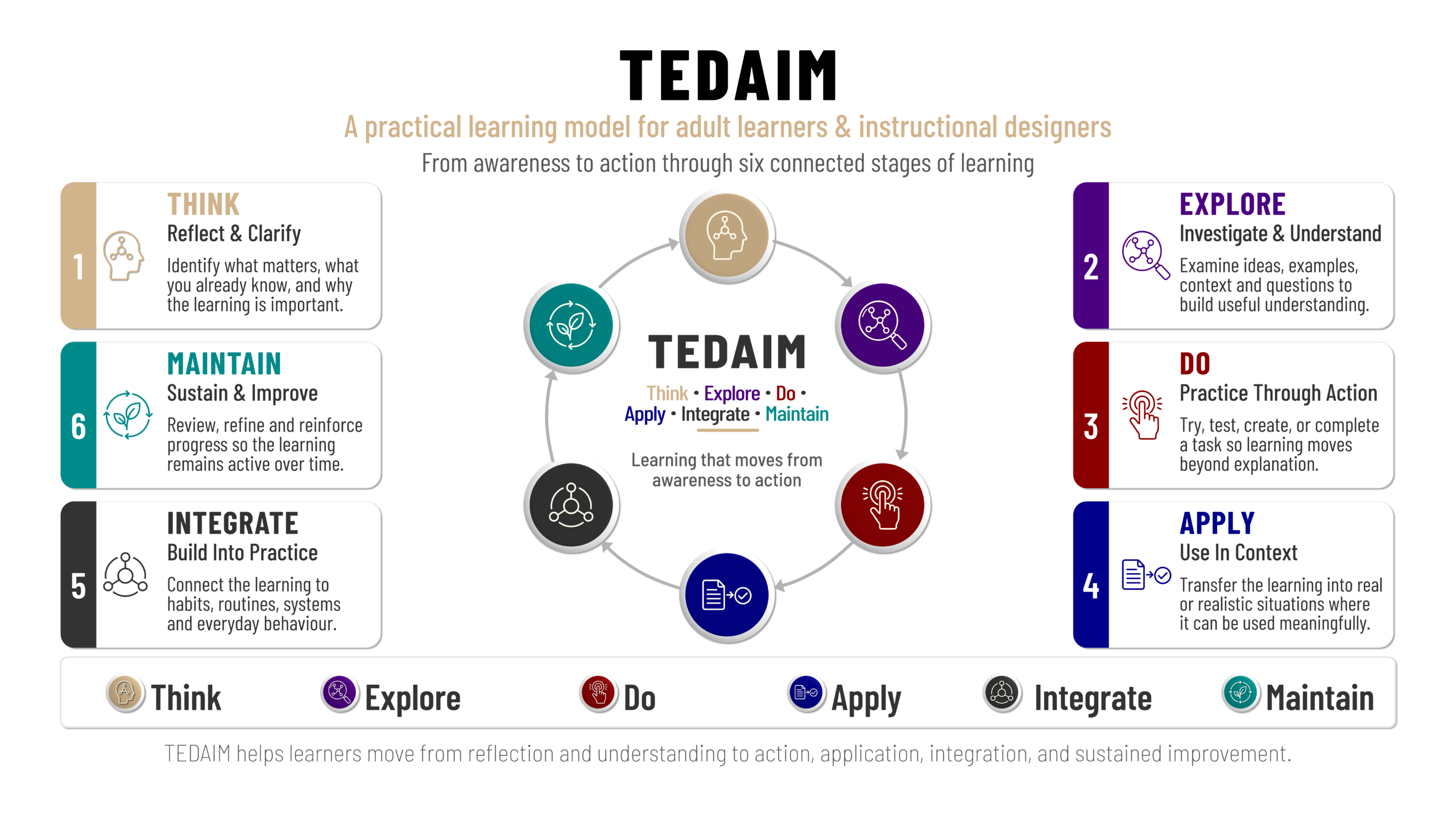
What TEDAIM Stands For
TEDAIM stands for Think, Explore, Do, Apply, Integrate and Maintain.
Each stage represents a different part of the learning journey. The model begins with reflection and understanding, then moves into action, application, integration and long-term maintenance.
This makes TEDAIM useful for adult learners because it recognises that learning is not only about receiving information. Real learning often requires practice, context, repetition, reflection and continued improvement.
- Think — clarify what matters and why.
- Explore — investigate ideas, examples and context.
- Do — practise through action.
- Apply — use the learning in a real or realistic situation.
- Integrate — connect learning to habits, routines and systems.
- Maintain — review, refine and sustain progress over time.
In simple terms, TEDAIM helps learners move from understanding a topic to using it meaningfully and sustaining progress over time.
Why TEDAIM Matters
Many learning experiences focus too heavily on information delivery. Learners may receive content, explanations, videos, slides or activities, but they are not always supported to transfer that learning into real action.
This is a common challenge in adult learning. Adults often learn while managing work, family responsibilities, financial pressure, changing technology, career transitions and limited time. They do not only need information. They need learning that helps them make sense of a topic, practise it, apply it meaningfully and keep improving after the learning experience ends.
TEDAIM matters because it treats learning as a process, not a once-off content event.
The problem
Learners may understand content but still struggle to apply it in real situations. This can happen when learning stops at awareness, explanation or completion.
TEDAIM response
TEDAIM helps learners move through reflection, exploration, practice, application, integration and maintenance so learning is more likely to become useful action.
In this way, TEDAIM helps shift learning from passive content consumption towards practical capability-building, behaviour change and sustained improvement.
The Six Stages of TEDAIM
TEDAIM guides learners through six connected stages. Each stage supports a different part of the learning journey, from initial reflection through to sustained progress over time.
Think
The Think stage helps learners pause, reflect and clarify why the learning matters.
It asks: What do I already know? Why does this matter? What problem, need or opportunity is connected to this learning?
For adult learners, this stage is important because they bring prior knowledge, experience, beliefs and expectations into the learning process.
Explore
The Explore stage helps learners investigate the topic more deeply.
This may include reading, watching examples, comparing ideas, reviewing case studies, examining scenarios and asking questions.
Explore is not about overwhelming the learner with information. It is about helping the learner build useful understanding.
Do
The Do stage moves learning into practical action.
This is where learners practise, attempt, test, create, complete or demonstrate something.
Examples include completing a task, using a tool, solving a problem, writing a response, practising a conversation or testing a method.
Apply
The Apply stage helps learners transfer learning into a real or realistic context.
This stage asks: Where can I use this? How does this fit my work, life or learning context? What would successful use look like?
Apply is different from Do. Do focuses on practice. Apply focuses on meaningful use in context.
Integrate
The Integrate stage helps learners connect new learning to existing habits, routines, systems, roles and identity.
This stage asks: How does this become part of how I work or think? What routine will help me continue using this?
What tools, reminders or systems could support me?
Integration matters because many learning experiences fade after the activity ends.
Maintain
The Maintain stage supports long-term progress.
It focuses on review, reflection, adjustment and continued use.
This stage asks: What is working? What needs improvement? What should I continue, adjust or revisit?
Maintain helps keep learning active beyond the initial course, lesson, article or workshop.
Together, the six stages help learners move from awareness to action, and from short-term understanding to sustained personal or professional growth.
TEDAIM At a Glance
This summary shows how each TEDAIM stage supports a different part of the learning journey, from initial reflection through to sustained improvement.
| Stage | Core Purpose | Learner Question | Typical Activity |
|---|---|---|---|
| Think | Clarify purpose and prior understanding. | Why does this matter? | Reflection, self-assessment or problem framing. |
| Explore | Build useful understanding. | What do I need to investigate? | Examples, case studies, comparison or guided discovery. |
| Do | Practise through action. | What can I try? | Task, exercise, simulation, tool use or practice activity. |
| Apply | Use learning in context. | Where can I use this? | Workplace task, real-life action or contextual scenario. |
| Integrate | Connect learning to habits, routines and systems. | How does this become part of my practice? | Checklist, workflow, routine, reminder or personal system. |
| Maintain | Sustain progress over time. | How do I keep improving? | Review, reflection, feedback or refinement. |
At a glance, TEDAIM shows that learning is not a single event. It is a structured movement from awareness to action, and from action to sustained improvement.
TEDAIM and Adult Learning
TEDAIM works well for adult learners because it recognises that adults do not learn in isolation from their lives.
Adult learners often bring prior experience, existing habits, work demands, family responsibilities, financial pressure, changing technology, career transitions and personal goals into the learning process.
This means adult learning needs to be practical, relevant, flexible and connected to real situations. TEDAIM supports this by giving learning a clear structure without making it rigid.
Why This Matters
Many adults do not need more content for its own sake. They need learning that helps them understand what matters, practise something useful, apply it in context and keep improving over time.
TEDAIM supports this by moving learning beyond passive consumption and towards practical capability-building.
Relevant
Adults are more likely to engage with learning when they can see why it matters and how it connects to their work, life or goals.
Practical
Adults often need learning that helps them do something, make a decision, solve a problem or improve how they operate.
Sustainable
Adults benefit from learning that can be integrated into habits, routines and ongoing practice, rather than ending after one activity.
TEDAIM supports adult learning by helping learners move through reflection, exploration, practice, application, integration and maintenance. This gives learning a practical pathway from understanding to sustained use.
TEDAIM in Practice
TEDAIM can be applied to many learning topics, including digital fluency, workplace learning, communication capability, learning agility and AI literacy.
The example below shows how TEDAIM can turn AI literacy from a general awareness topic into a practical learning journey.
Example: AI Literacy
Think
Learners reflect on how they currently use AI, what they are uncertain about, and where they may need stronger judgement, confidence or support.
Explore
Learners explore what AI tools can and cannot do, including common uses, limitations, risks, ethical concerns and the need for verification.
Do
Learners practise using AI for a small, realistic task, such as summarising information, clarifying a brief, generating draft ideas or improving a piece of content.
Apply
Learners apply AI to a real workplace, learning or personal task while checking the output carefully and deciding what still requires human judgement.
Integrate
Learners build responsible AI use into a repeatable workflow, including when to use AI, how to check outputs and when to rely on their own expertise.
Maintain
Learners review how AI is supporting their work or learning, refine their habits, improve their prompts and continue strengthening judgement over time.
In this example, TEDAIM helps AI literacy become more than awareness of a new tool. It becomes a practical process for building confidence, judgement, responsible use and long-term capability.
Frequently Asked Questions
These questions summarise the key points about TEDAIM and how the model can be used in adult learning, instructional design, microlearning and practical capability-building.
What does TEDAIM stand for?
TEDAIM stands for Think, Explore, Do, Apply, Integrate and Maintain. These six stages guide learners through a practical process of reflection, understanding, action, application, integration and ongoing improvement.
What is TEDAIM used for?
TEDAIM is used to structure practical learning experiences that help adults move from awareness to action. It can support self-directed learning, workplace learning, microlearning, instructional design, coaching, digital fluency, AI literacy and broader capability-building.
How does TEDAIM support adult learning?
TEDAIM supports adult learning by recognising that adults bring prior experience, responsibilities, habits, goals and real-life constraints into the learning process. The model helps make learning more relevant, practical, flexible and connected to application.
How is TEDAIM useful for instructional design?
For instructional designers, TEDAIM provides a practical way to plan learning beyond content delivery. It encourages designers to consider what learners should think about, explore, practise, apply, integrate and maintain after the learning experience.
Can TEDAIM be used for microlearning?
Yes. TEDAIM can be used to structure microlearning by turning each stage into a focused learning moment, such as a reflection prompt, short explainer, practice task, real-world application step, integration checklist or follow-up review question.
Is TEDAIM only for formal courses?
No. TEDAIM can be used in formal, informal and self-directed learning. It can support courses, workshops, coaching conversations, learning resources, workplace activities, personal development plans and practical learning journeys.
Is TEDAIM an accredited learning model?
TEDAIM is a practical GravityWRX learning model. It is not presented as an accredited, credit-bearing, SAQA-aligned or qualification-bearing framework.
In short, TEDAIM helps learners and learning designers treat learning as a practical process: from reflection and exploration to action, application, integration and sustained improvement.
Explore Learning with GravityWRX
GravityWRX uses TEDAIM to design practical learning resources for adults who want to build confidence, capability and lifelong learning habits.
Explore more GW resources on adult learning, digital fluency, AI literacy, microlearning and practical capability-building.
Learning that moves from awareness to action.