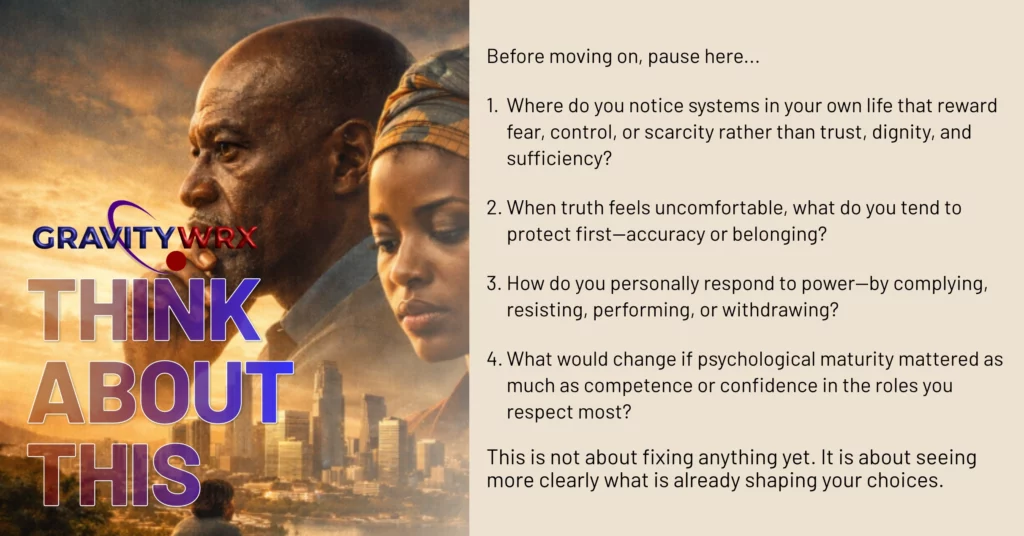
We are not failing from ignorance, but from systems built on fear, scarcity, and unexamined power.
We already know what would make us flourish.
- A life with fewer unnecessary, human-made obstacles.
- Truth that is not filtered through fear, ego, or advantage.
- Communication that clarifies instead of wounds.
- Dignity that is not conditional.
- Enough for everyone, instead of excess for a few.
These ideas are not radical. They appear in every spiritual tradition, ethical system, serious psychological model, and human rights charter.
We have named them, studied them, taught them, and even built entire institutions around them.
Yes, the lived reality for most people feels a galaxy away from this vision.
The honest question is not: Do we know what a better world looks like?—but: Why, with all our knowledge, do we keep reproducing its opposite?
Here is the uncomfortable answer: We are not failing because of a lack of intelligence, information, or good intentions, but because immature psychological operating principles continue driving our approaches.
The Progress Illusion
We appear advanced on the surface; we speak the language of wellbeing, inclusion, emotional intelligence, mental health, and human rights, we have access to more research, communication tools, and increased economic capacity than any generation before us—but underneath the language of progress, the reward structure remains archaic.
Competition is still valued over cooperation, image over integrity, control over consciousness, accumulation over sufficiency, and performance over presence.
We may resemble modernity but still operate from places of fear.
Power Without Maturity
Most leadership systems select for confidence rather than self-awareness, for certainty rather than emotional regulation, for charisma rather than psychological integration.
Unintegrated egos scale very efficiently. When fear, insecurity, and unresolved identity wounds gain access to authority, they do not disappear—instead, they become policy, culture, and the way things are. This is how truth becomes filtered, how communication becomes strategic rather than sincere, and how people become resources rather than human beings.
Not because leaders are monsters, but because power amplifies whatever inner development has (or has not) occurred.
Scarcity by Design
Often, we speak about inequality as though it is an unavoidable law of nature. Still, it’s not—in reality, it is a structural choice. Our economic and social organisms are built on comparative value.
More than. Better than. Above. Ahead.
Enough for all is deeply destabilising to models and frameworks that depend on hierarchy, competition, and artificial lack. So, while we speak of fairness, the system’s architecture quietly rewards accumulation over sufficiency.
Scarcity today is less about the resources and more about the incentives.
Identity Over Truth
We like to think we are truth-seeking creatures, and in practice, we are belonging-seeking ones.
Increasingly, we ask:
- Does this protect my group?
- Does this affirm my identity?
- Does this keep me safe socially and psychologically?
And this is before we ask: Is it true?
When identity is threatened, truth becomes negotiable. Communication becomes defensive. Dialogue becomes performance. Listening becomes rare. And respect erodes not because people are cruel, but because they fear losing psychological ground.
Communication Without Safety
Respectful, uplifting communication requires inner security; clarity requires emotional regulation; and truth requires the courage to be unarmoured.
However, most organisations keep people in a state of chronic comparison, evaluation, and threat. In such conditions, people do not speak to understand; they talk to survive, justify, dominate, or protect.
We do not have a communication crisis, but a safety crisis.
The Dignity Gap
We declare dignity as a value, yet withdraw it the moment productivity, profitability, ideology, or hierarchy feels at risk. We say everyone matters, but we behave as though some lives are more tolerable losses than others. Dignity remains a slogan until it is structurally protected—not merely morally admired.
The Real Diagnosis
The obstacle is not ignorance or even malice; it is that our outer approaches have evolved faster than our inner development.
We’ve built sophisticated institutions on unexamined fear, historical trauma, and immature psychological models of power and worth. We have scaled intelligence faster than wisdom, and capability faster than consciousness.
So, are the ideals naïve?
No.
What is naïve is believing that ethical futures can be built without emotional maturity, psychological integration, and moral courage becoming core selection criteria for leadership, success, and influence.
A humane world is possible, but not through slogans alone, not through policies alone, and not through technological progress alone. It will require inner evolution to catch up with outer power, finally.
But, until then, we will keep knowing what is right—and structurally rewarding what is not.