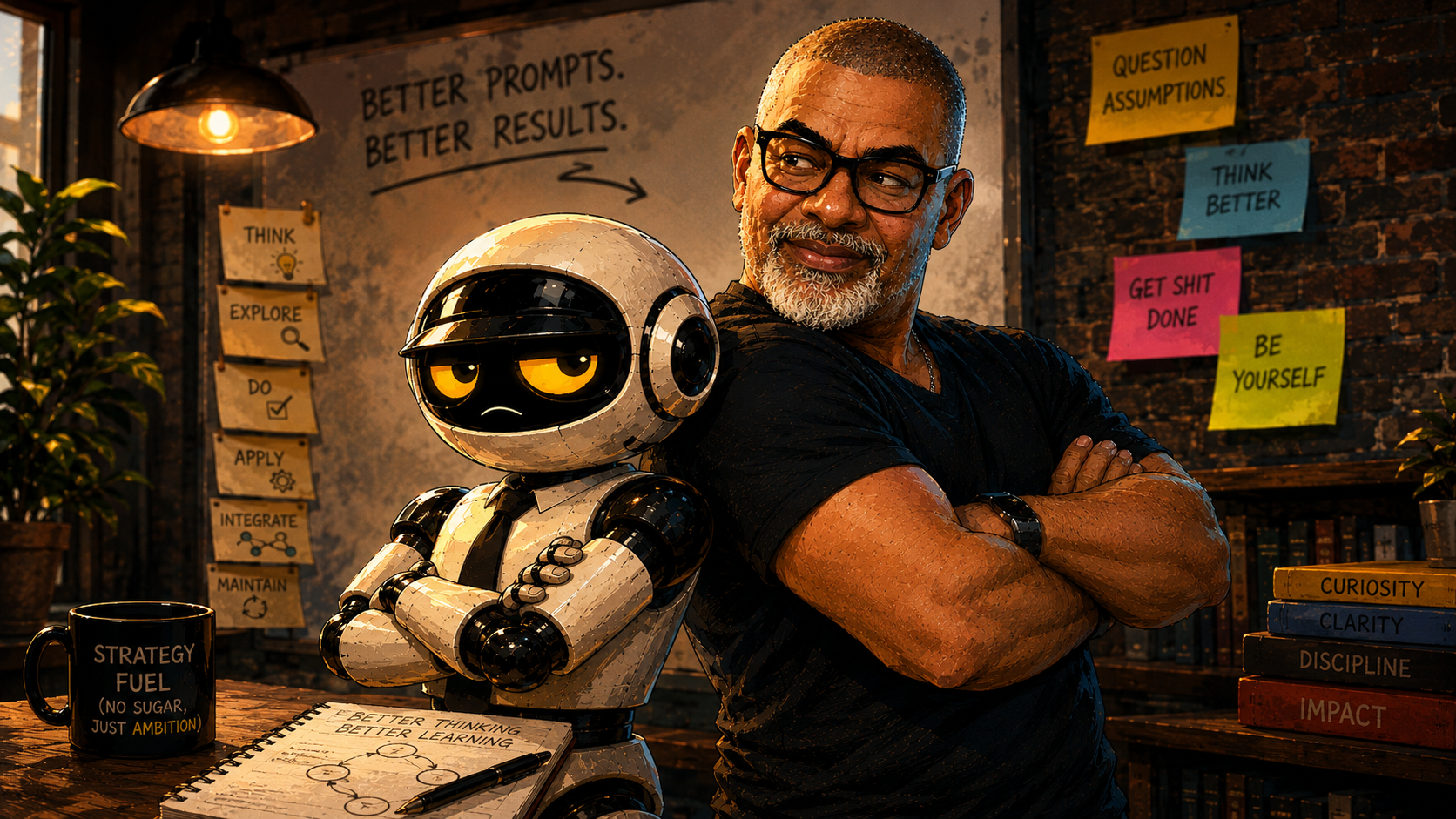
Somewhere between rewriting a learning objective for the fourth time and arguing with a robot about whether a heading sounded unnecessarily corporate, I realised something important:
Instructional design is changing. Not disappearing. Not collapsing into chaos. Just changing.
And honestly, it was overdue.
For years, instructional designers have quietly carried entire learning ecosystems on their backs while pretending that “rapid development timelines” were perfectly reasonable requests from stakeholders who believed meaningful learning could be assembled from a PowerPoint template, stock photography, and blind optimism.
We became:
- researchers,
- writers,
- facilitators,
- editors,
- learning strategists,
- visual communicators,
- accidental psychologists,
- project managers,
- and occasional therapists for stakeholders requesting “something more engaging” three days before rollout.
Then artificial intelligence entered the conversation, and the professional panic began almost immediately.
Suddenly everybody wanted to know: “Will AI replace instructional designers?”
Personally, I think that question misunderstands the work entirely.
Good instructional design was never simply about producing content. It was always about producing thinking, and that distinction matters more now than ever.
A slide deck is not instructional design.
An e-learning module is not instructional design.
Even a beautifully animated course with cinematic transitions and inspirational ukulele music does not automatically qualify as instructional design.
Real instructional design is the structured movement from confusion toward capability. And AI, when used properly, can strengthen that movement dramatically. Not because it replaces expertise, but because it exposes weak thinking faster than most project meetings ever could.
AI is remarkably good at revealing:
- vague objectives,
- bloated explanations,
- unsupported assumptions,
- incoherent sequencing,
- performative jargon,
- and learning activities that only exist because somebody attended a workshop in 2014 and emotionally never recovered.
It is, in many ways, the most judgemental junior colleague imaginable: relentlessly available, wildly fast, occasionally incorrect, frequently useful, and absolutely convinced it understands what you meant.
Which means instructional designers are entering a fascinating phase of professional evolution.
The advantage no longer belongs exclusively to the person who can produce content fastest. Increasingly, it belongs to the person who can:
- frame better problems,
- structure clearer thinking,
- evaluate outputs critically,
- identify meaningful learning gaps,
- maintain human relevance,
- and guide AI toward purposeful learning outcomes.
In other words, the role becomes less mechanical and more intellectual. Ironically, AI may force instructional designers to become more deeply instructional designers again. Once the production barrier lowers, judgement becomes the differentiator.
Not decoration.
Not templates.
Not whether the buttons slide in from the left while corporate background music whispers softly underneath.
Judgement.
The ability to decide:
- what matters,
- what should be simplified,
- what should remain difficult,
- what learners genuinely need,
- and whether learning is happening or merely being performed theatrically inside an LMS.
This shift is partly why my own work evolved into TEDAIM:
Think, Explore, Do, Apply, Integrate, Maintain.
TEDAIM was never designed as a rigid formula or trendy acronym pretending to solve human complexity in six convenient steps. It developed through repeated questioning about how adults learn, struggle, apply knowledge, sustain behaviour, and build capability over time.
Interestingly, AI became part of that refinement process. Not because AI invented the framework, but because AI pressure-tested it relentlessly.
The process forced deeper questions:
- How does capability develop?
- Why does knowledge fail to transfer?
- What causes motivation to collapse?
- Why do some learning interventions feel technically complete but behaviourally ineffective?
- What does sustainable learning look like in real adult life?
And most importantly: AI forced me to slow down and think more clearly. Which feels deeply ironic considering the technology is designed for speed. But speed without reflection produces noise, and instructional designers understand this instinctively.
Most of us have experienced the corporate learning equivalent of somebody uploading twelve PDFs into an LMS and calling it “digital transformation.” AI simply accelerates the consequences of weak thinking.
Which means strong thinking becomes exponentially more valuable.
That is why I believe the future of instructional design may become less about content factories and more about learning architects. Less about producing volume. More about producing meaningful capability. Less about information delivery. More about intellectual scaffolding.
Most importantly, perhaps, less about treating learners as passive recipients and more about helping people navigate complexity with dignity, reflection, and practical confidence.
That future requires instructional designers who can:
- think critically,
- challenge assumptions,
- analyse context,
- structure learning intentionally,
- and collaborate responsibly with AI instead of blindly outsourcing judgement to it.
Because despite the hype, AI still cannot replace:
- contextual awareness,
- learner empathy,
- ethical reasoning,
- operational understanding,
- or professional discernment.
It can, however, become an extraordinarily useful thinking partner.
Occasionally an annoying one!
Somewhere inside my own process still lives a mildly judgemental robot project manager quietly asking:
“Just following up on the below…”
Frankly, that part feels realistic enough to keep.
Download the Free TEDAIM Prompt Starter Guide
To support more thoughtful experimentation with AI in learning design, I created a free downloadable resource:
AI Prompts for Instructional Designers: A TEDAIM-Informed Starter Guide
The guide explores practical prompts aligned to: Think, Explore, Do, Apply, Integrate, and Maintain.
It is designed to help instructional designers:
- interrogate assumptions,
- strengthen learning strategy,
- improve reflective practice,
- structure capability development,
- and use AI more critically and responsibly.
Because the real value is not the prompt itself. It is the quality of thinking behind the prompt.