What rebuilding one page taught me about visibility, structure, AI-readable content and purposeful learning design.
There are moments in a build where you realise you are doing more than improving a page, you are changing the way you understand the work. That is what happened when I rebuild the What is TEDAIM? Page for GravityWRX.
Initially, the task seemed straightforward—the TEDAIM page needed to explain the learning model more clearly. It must show what TEDAIM stands for, how the stages work, and why the model matters for adult learners. But the deeper I went into the rebuild, the more I realised that this was not only a page design exercise. It became a practical test of TEDAIM itself. I was using TEDAIM to rebuild the page that explains TEDAIM.
That may sound a little recursive, but it became on of the most useful learning moments I’ve had while building GravityWRX.
Why the Page Needed to Change
The earlier iteration of the TEDAIM page was not wrong. It simply did not yet do enough.
It explained the model but did not fully show how TEDAIM connects to the wider GravityWRX ecosystem. It did not make the learning journey clear enough for someone arriving on the page for the first time. It also lacked reflection about how central TEDAIM has become to the way I think about instructional design, blog writing, microlearning, AI collaboration, learning content development and lifelong learning.
That mattered.
TEDAIM is not a decorate acronym, it is the practical learning model on which GravityWRX sits. It helps structure how people move from awareness to action, and from action to sustained improvement. I wanted the page to help a visitor understand that quickly.
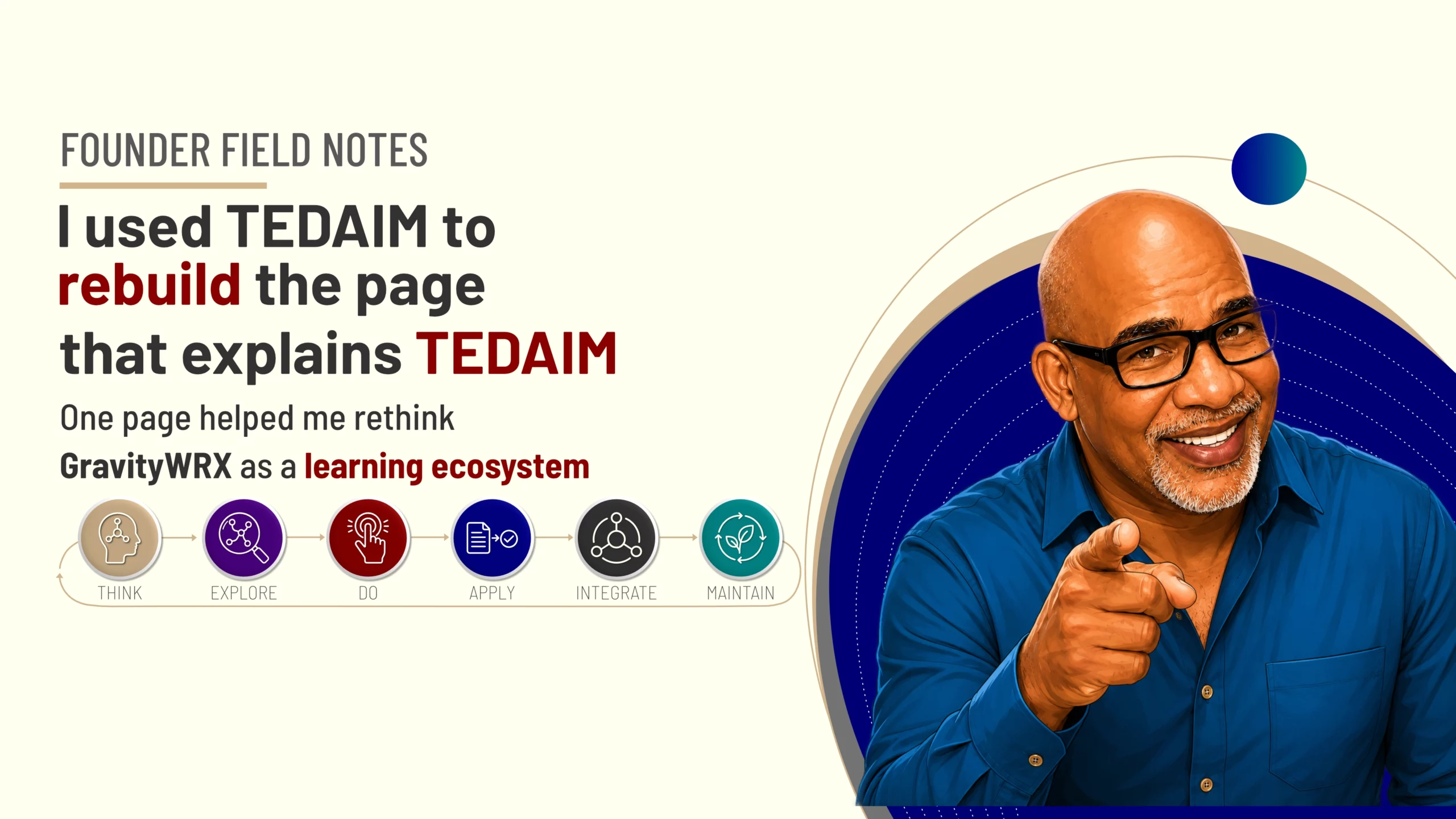
Within the first thirty seconds, I wanted someone to know that TEDAIM is a six-stage learning model developed by GravityWRX; that it helps adults from awareness to action, that it is practical rather than abstract, and that it can support formal, informal, and self-directed learning. It also supports instructional design, microlearning and continuous development.
Without a doubt, formal training still has its place—but now it is not the only way adults learn, grow or build capability. TEDAIM needed to communicate that.
Think: Noticing the Visibility Problem
The THINK stage began when I realised that visibility was not only about publishing more content.
GravityWRX had content, ideas, and a developing structure. But the site was not yet showing up strongly as I wanted it to. Traffic was not shifting meaningfully. The right audience was not being pulled clearly into the GravityWRX world.
I kept asking myself a difficult question: How do I help the right people find this work, understand it, engage with it, and eventually trust it enough to explore resources, eBooks or future learning products?
I did not want to chase virality. That was never my goals. I’m not trying to become an influencer, and I do not want GravityWRX to sound like another motivational content machine. The aim is different. I was GravityWRX to become useful.
Useful for adults who are tired of vague advice, for instructional designers who want learners to move beyond content delivery, and useful for people who want practical, structured ways to build capability.
Then I came across the distinction between SEO, AIO and GEO, and something clicked.
I could write about AI, learning and capability-building until I was blue in the face. But if the website was not structured for how people and AI systems now find, extract and connect information, the work could still fade quietly into the background.
That was the real Think moment.
The issue was not only content; it was structure, clarity, and discoverability.
Explore: Seeing the Website as a Learning Ecosystem
The Explore stage was where things opened, and I began exploring SEO, AIO, and GEO more deliberately.
In simple terms:
- SEO (Search Engine Optimisation) helps people find a page through search engines.
- AIO (AI Optimisation) helps AI-generated answers extract useful information from a page.
- GEO (Generative Engine Optimisation helps generative AI systems understand how a brand, model, topic, or ecosystem is connected and should be represented.
That distinction changed how I saw the TEDAIM page.
The page needed to be more than a description of the model, it had to become a knowledge asset. It had to help readers, search engines, and AI tools understand what TEDAIM is, how it works, why it matters, and how it connects to GravityWRX, the Resource Library, the GW Journal and future learning products.
With ChatGPT as a thinking and building partner, I worked through the structure of the page step-by-step. The collaboration helped me explore what the page needed to do, how the sections should flow, and how Elementor could be used more intentionally.
This is also where I began to see Elementor differently.
Previously, I understood enough to build pages. But during this rebuild, I started to understand the design system behind the build: outer containers, inner containers, spacing, padding, cards, table, accordions, responsive settings, shadows, typography and page rhythm.
Elementor was no longer just a tool I was using, it becomes something I could shape to support the learning experience—and that was a significant shift.
Do: Rebuilding the Page Through Practice
The DO stage was practical and hands-on. I rebuilt the page structure in Elementor section-by-section; and the new page included:
- a clear hero section;
- a Quick Answer box near the top;
- a simplified TEDAIM infographic;
- a Table of Contents;
- an explanation of what TEDAIM stands for;
- a section on why TEDAIM matters;
- detailed stage cards for Think, Explore, Do, Apply, Integrate and Maintain;
- a “TEDAIM at a Glance” table;
- a section on TEDAIM and adult learning;
- a practical example of TEDAIM in action;
- a Frequently Asked Questions section;
- and a final call to action.
Each part had a job to do.
The Quick Answer provided immediate clarity. The infographic visually illustrates the model. The Table of Contents helps the readers navigate the page. Cards made the stages easier to scan and understand. The table summarised the model. The practical example shows that TEDAIM can be used, not merely explained. The FAQ supported search-style questions. The CTA guided visitors deeper into the GravityWRX ecosystem.
This was not a single design action, but a beautiful, complex series of small decisions.
I adjusted spacing, refined test, and tested the page repeatedly. I redesigned the infographic in Affinity Vector, applied the GravityWRX colour palette, adjust typography and fonts to be responsive on different devices. Added soft shadows, fixed spacing, refined cards, and corrected a sticky header issue that’s been bothering me for some time.
Some of this was design. Some of it was learning. Much of it was both.
I rebuilt the page by doing, testing, adjusting and doing again—that is very TEDAIM.
Apply: Making the Page Work for People
At some point, the work shifted from building a page to making the page work for people. That distinction matters.
A page can look attractive and still fail the visitor, it can be visually polished and still leave people uncertain about the next step, it can explain a concept and still not help someone understand why the concept matters.
The Apply stage asked a different question: How does this page help a real person?
For a first-time visitor, the page needed to answer quickly:
- What is TEDAIM?
- Why does it matter?
- How does it work?
- How could I use it?
- Where should I go next?
The Table of Contents became a major turning point; it makes the page easier to navigate; it reduces friction and turned a long page into a navigable learning experience.
I also started understanding internal linking differently.
A Table of Contents helps people move within a page, internal links help people move across the website—and both matter, but they do different jobs.
Before this rebuild, I though about internal links in a more basic way. Link the word “TEDAIM” here. Point it to a related post there. But the rebuild helped me see internal linking as part of the learning journey.
If GravityWRX is meant to become a practical learning ecosystem, visitors should be able to follow one idea into another. A person reading about TEDAIM should be able to move naturally into adult learning, AI literacy, digital fluency, microlearning, the Resource Library, the GW Journal and future eBooks.
I wanted the site to become a purposeful knowledge pathway, not a content dumping ground. Not a place where people land and say that’s nice and leave. I want visitors to find useful ideas, following meaningful connections and experience regular aha moments.
That is when a website becomes more than a website, it becomes part of the learning experience.
The Discovery Shift: SEO, AIO and GEO
The rebuild also changes how I think about discoverability. I had a basic understanding of SEO for some time; but AIO and GEO were newer concepts to me. Once I began exploring them, they made immediate sense within the GravityWRX context.
- SEO is about helping a page become findable.
- AIO is about helping AI-generated answers understand and extract useful information from a page.
- GEO is about helping generative systems understand the wider relationship between ideas, pages, models and brands.
For GravityWRX, this matters deeply.
TEDAIM is not only a page topic, but also a core model. GravityWRX is not only a website but also becoming a practical learning ecosystem. The Resource Library, GW Journal, eBooks, microlearning resources and future learning products all need to connect in ways that make sense to people and to AI systems. And…it does not mean stuffing pages with keywords, it means building pages with clarity, structure, and purpose.
It means answering real questions, consistent terminology, and connecting related ideas; making learning easier to find, understand, use, and revisit.
In many ways, SEO, AIO and GEO are not separate from learning design. They are becoming part of how online learning content needs to be structured.
If people cannot find the learning, they cannot use it. If AI systems cannot understand the learning, they cannot represent it accurately. If the site does not connect its ideas clearly, the ecosystem remains fragmented.
That was a major lesson from rebuilding one page.
Integrate: Turning the Rebuild into a GW Standard
The Integrate stage is where the page rebuild become something bigger, and this is the structure I aim to use for future cornerstone pages. A strong GravityWRX page should include:
- a clear opening definition;
- a Quick Answer section;
- a visual model or infographic where useful;
- a Table of Contents for longer pages;
- structured explanations;
- practical examples;
- a connection to TEDAIM;
- FAQs;
- internal links;
- and a clear next step.
That structure can be adapted for future pages such as:
- What Is AI Literacy?
- What Is Digital Fluency?
- What Is Microlearning?
- What Is Learning Agility?
- What Are Critical Skills?
The visual system also matters: TEDAIM colours, clean typography, comfortable spacing, structured cards, and practical layouts should become part of the GravityWRX identity.
Integration is not only visual, but also editorial. GravityWRX content must remain practical, clear, useful and non-fluffy. It cannot become another stream of polished but empty development advice. Learning content, resources, and products are everywhere—and that’s not enough.
GravityWRX must help people think, explore, do, apply, integrate and maintain something useful.
If a page, post, resource, or product does not help the visitor navigate through some part of that learning process, then it does not belong in the GravityWRX ecosystem.
That may sound strict. Good! The internet has enough content soup, GravityWRX needs learning that works.
Maintain: Keeping the Ecosystem Alive
The Maintain stage is where the work continues. Publishing the page is not the end of the process; it is the beginning of the maintenance cycle.
Now, I need to keep checking how search engines and AI-generated results represent TEDAIM. I need to review whether visitors can easily navigate from the TEDAIM page to the Resource Library, the GW Journal and future eBook offerings. The terminology must remain consistent.
Is TEDAIM described as a learning model, a framework, a lifelong learning model, or a practical learning structure?
The language matters because consistency helps people understand the model and helps AI systems represent it accurately.
My next step? I also need to update older pages, so they align with the new standard. Future blog posts, LinkedIn posts, eBooks, microlearning assets and resources should link back to TEDAIM where relevant.
As TEDAIM evolves, the page must evolve too—and that is maintenance. Not maintenance as admin, but as learning stewardship.
The Proof of Concept
Shortly after rebuilding the page, I search for What is TEDAIM? On Google. The page appeared.
Even more encouraging, Google’s AI-generated results began picking up the TEDAIM page and connecting it to other GravityWRX pages. That was a small but important Proof Of Concept. It demonstrated that structure matters.
The page had become easier to find, understand, and easier for AI systems to connect to the wider GravityWRX ecosystems.
Of course, one result does not mean the work is done, or that the whole system is suddenly optimised, but it does mean visibility is solved. And it does show that a carefully structured page can begin to do what it is meant to do.
That is worth paying attention to.
Building Through Transition
There is a more personal layer to this.
GW began as a long-term direction and in many ways, it was meant to become part of a future retirement pathway, something I could build carefully, steadily and intentionally over time. Recent circumstances have changed the urgency.
GravityWRX is no longer a future option, but something I need to build now, with clarity, discipline and care. That reality sharpens the work and makes visibility critical; it makes structure matter and makes practicality matter.
If GravityWRX is to become a real learning ecosystem, it cannot be vague, or decorative, and it cannot simply curate content and hope that people will understand the value.
Instead, it must guide, teach connection and help move adult learners from I know I need to learn to I know what to do next.
What This Rebuild Taught Me
Rebuilding the TEDAIM page taught me that designing a website page can be a learning experience.
It can introduce an idea, define it clearly, show it visually, organise it logically, provide examples, answer questions, and guide the visitor towards deeper exploration.
That is not just web design. That is learning design.
It also taught me that AI collaboration works best when it is paired with human judgement. ChatGPT helped me think through structure, wording, page flow, and design decisions. But the direction still had to evolve from the learning process, the GravityWRX brand and the role TEDAIM needs to play in the ecosystem.
AI supports the process but cannot care about the integrity of the model—that part remains mine.
Founder Field Note
This is the type off reflection I want to continue through Founder Field Notes; honest notes from building GravityWRX one learning asset, one page, and one practical decision at a time. I don’t want to only share polished success stories, or inflated case studies—and not look how perfect this all is. Rather, field notes from the build: what worked, what shifted, what I noticed, what I changed, and what I learned.
Because GravityWRX is still being built, it is not yet the full learning ecosystem I can see in my head, but it is becoming a practical space for adult learners, instructional designers, and people who want clearer ways to build capability.
And this TEDAIM page showed me something important. GravityWRX does not need more content for the sake of content, it needs connected learning assets that help people move from awareness to action, from information to application, and from scattered ideas to structured development.
That is the work now.
Explore the Rebuilt TEDAIM Page
If you are new to TEDAIM, start with the rebuilt page
Then ask yourself: How do you currently structure your own learning? Do you stop at awareness, or do you move towards action? Do you give yourself enough space to apply, integrate and maintain what you learn?
That is where TEDAIM becomes useful…Not a slogan. But, to build learning that does something!